The catalyst for this article was seeing a transcription of his will which had been undertaken by one of the volunteers involved in transcribing wills on behalf of the Hook Norton Village Museum. Property owned by him in the village meant that it was included in Hook Norton Wills.
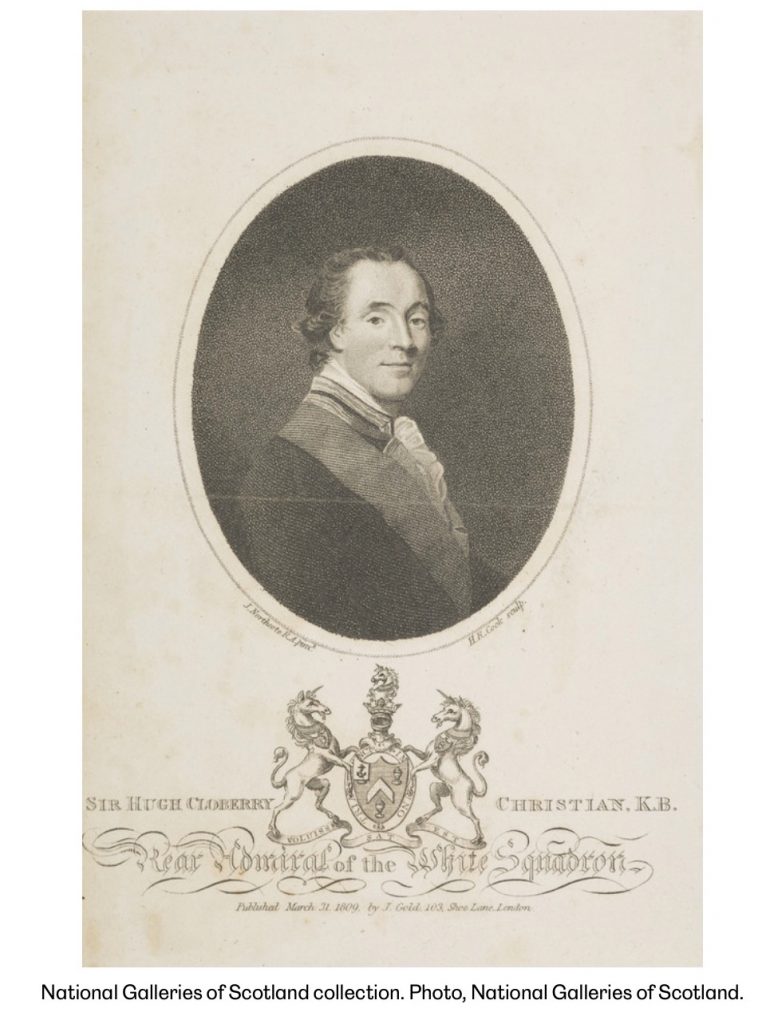
So who was Hugh Cloberry Christian? Born in 1747 in London he was a member of a well known family whose origins were in the Isle of Man. He is noted among A W Moore’s “Manx Worthies”. Several generations before him had served in the Royal Navy and Hugh followed suit serving in the West Indies between 1779 and 1783 rising through the commissioned ranks until in 1793 he was appointed chief of command as an admiral at the Cape of Good Hope in South Africa. He died suddenly in 1798 whilst there and was buried in South Africa. Just prior to his death a peerage had been conferred on him. Mindful of his Manx roots he had elected the title of Lord Ronaldsway.
Hugh entered the navy, aged 14, in 1761, his early service being in the English Channel and the Mediterranean. He was commissioned a lieutenant in 1771 having passed his examination 4 years earlier. He married Anne Leigh on 6 March 1775 who bore him 5 children. The eldest Hood Hanway Christian born in 1784 served with his father and died a rear admiral in 1849.
In November 1975 he set sail with a fleet of 200 naval and merchant ships for the Leeward Islands in a bid to capture them from the French who, at that time, had control. His flag was flying in Prince George (98 guns). A violent gale caused many of the vessels to be driven back some in a shattered condition. Shifting his flag to the Glory, also 98 guns, he made a second attempt leaving on 9 December. However, a further storm resulted in the fleet scattering once more with Glory and 50 others making safe haven at Spithead. Some of the naval and merchant ships did arrive in the West Indies, with some foundering and others captured. As a result these atrocious weather conditions were perhaps unkindly nicknamed “Christian’s Gales”. It was not until March 1796 that he finally was able to set sail for the Caribbean on board Thunderer, a 74 gun two deck Line-of-Battle ship. Thunderer was cutting edge for her day serving until 1814 when she was broken up. Christian’s fleet provided naval support for Sir Ralph Abercromby in the conquest of St Lucia which capitulated on 25 May shortly followed by Grenada and St Vincent.
The month before his departure for the West Indies he had been created a Knight of the Bath. However, not all of his naval career was plain sailing as parts were not without controversy. He had fallen out with Captain John Schank over the arrangements for the expedition. According to a naval history website a duel between the two seemed inevitable despite reconciliation by government ministers. However, when Hugh returned to England in October 1796 it was reported that the differences had been resolved. It cannot have been innocuous as it even attracted a mention in the Norfolk Chronicle of 27 February 1796.
In September 1797 he was appointed commander at the Cape. Sailing the following month he arrived there in early January 1798. He died suddenly from a seizure on 23 November 1798 and was buried there. His wife Ann having suffered from illness only survived him by two months never having learned of his death.
Hugh was well regarded by his contemporaries as a calm and confident officer albeit with a temper if crossed. He was on friendly terms with senior politicians such as William Pitt and Henry Dundas. He was also a favourite of Admiral Lord Howe and an early patron of the surveyor Sir Francis Beaufort after whom the Beaufort Scale, which measures wind force, is named. The book Manx Worthies paid the following tribute to him “His services had been arduous and useful; and by his death the country lost an attentive, able and active officer.”
Where did the connection with Hook Norton originate? For that we have to go back in time to his grandmother Letitia Brucer (approx 1689 – 1768) and her parents Anthony Brucer and Mary Awsiter. The Awsiters were a well known and powerful family from Southall in Middlesex. Anthony Brucer had property in Hook Norton as was noted in his will. Whilst there was a marriage certificate between Anthony and Mary it was claimed to be falsified and apparently Anthony made Mary sign a document confessing to the false marriage and never to use his name again. When Anthony died the terms of his will were such that all of his estate be left to impoverished clergymen. Letitia challenged this in 1757 and successfully argued that she was Anthony’s rightful heir at law. Her first husband was Hugh Christian (1679-1727) while her second was Thomas Mascall. However both husbands were dead when the court case was heard. Anthony’s will mentioned several properties in Hook Norton including a manor called Dymock’s (Dimockes) Manor which was in the possession of Mr Lampitt. The Lampitts or Lampetts were a well known village family in those days. “Dimmocks Fee” was a small estate which acquired its own manor court in the 13th century and was held in time by the Dimmock family. Ownership was retained by various successors over the next few centuries until the 18th when the manor was held by Anthony Brucer. To us today a manor would probably refer to a specific property but in the 18th century it was not necessarily all one property but could have been fields, other lands and houses which were perhaps spread out around a village.
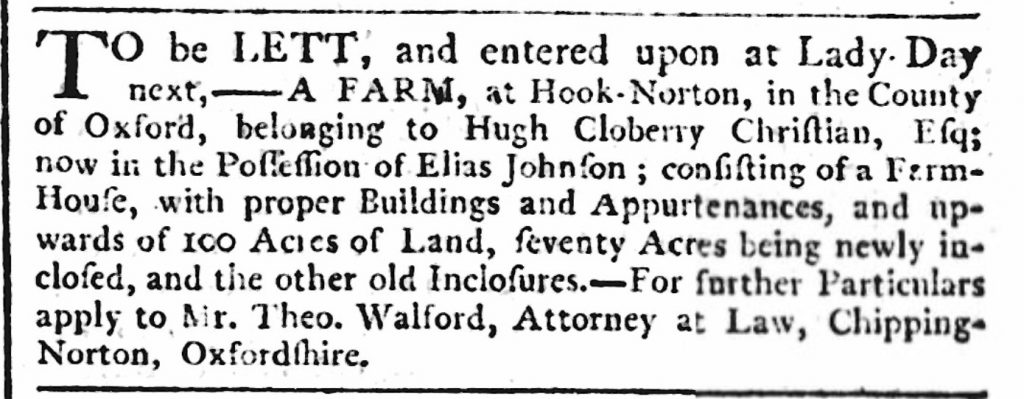
It is not known if Letitia had any children from her second marriage to Thomas Mascall however, there were known to be four children from her first one. Thomas b1719 was the third child but the only one known to have survived into adulthood. He was baptised on 2 November 1719 at St James, Clerkenwell, London and married Ann Hughes on 28 August 1746 in Hampstead which was then regarded as being in Middlesex. Thomas served in the Royal Navy but was dismissed for drunkenness in September 1748. There is a story that he bought property in Hook Norton with the proceeds of privateering but this is not substantiated. It has been mentioned to me that he was possibly killed in London in a fight over a gambling debt. Thomas died in 1752, some 5 years before Letitia successfully challenged her father’s will. She died in 1769 leaving Hugh Cloberry Christian, her grandson, a substantial property in Hook Norton. An advertisement in Jackson’s Oxford Journal dated 20 November 1779 shows a property to let in Hook Norton currently owned by Hugh.
As mentioned earlier Hugh married Anne Leigh and I am aware of five children born between 1775 and 1792. Of course with his naval service overseas it would explain the largish gaps, well for those days, between the birth years. Some of their children continued the military tradition started by their ancestors. In addition some entered the ministry which was not an uncommon thing to do.
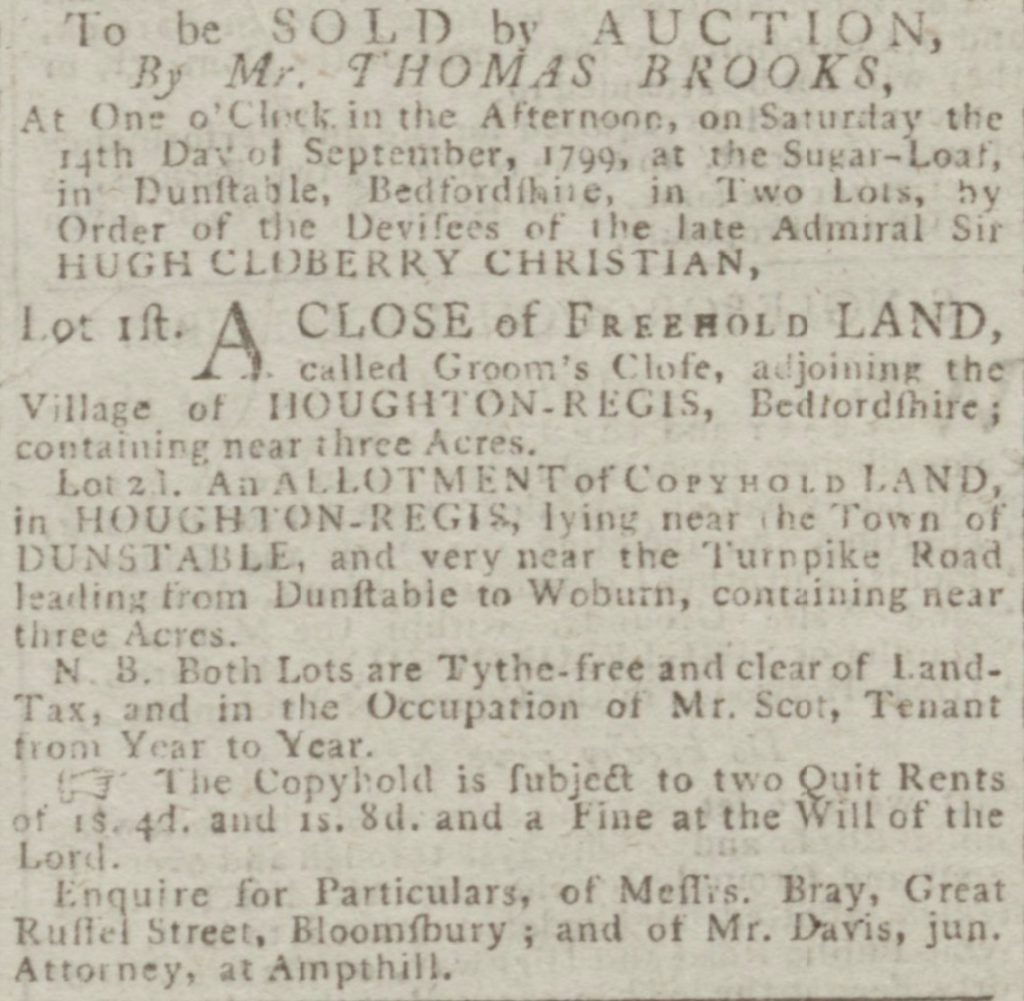
At the time of High’s untimely death he still owned property in the village and also in Bedfordshire. The Northampton Mercury of 24 August 1799 refers to the forthcoming sale of land in Houghton Regis near Dunstable owned by the late Hugh Cloberry Christian and presently tenanted.
The esteem in which he was held within the Christian family is reflected in the marriage notices of some of his grandchildren. One such notice was that of Harriet Christian who married Arthur Treherne on 1 September 1864. Harriet was the fourth of Hood’s six children. As readers are aware Hood served with his father during his own naval career so it probably seemed fair to mention her illustrious grandfather. A few years later, in 1873, Harriet wrote a book “Romantic Annals of a Naval Family” which possibly paints a more flattering picture of the family. Hood believed it to be a true account of his father’s life. One thing in the book that struck me was the reference to a black servant named Topaze, “clad in the gorgeous livery of that period”, (we are talking about 1755), who acted as a companion for young Hugh. The book also describes the manor house in Hook Norton where Hugh spent much of his childhood. In this respect Hugh did spend part of his life in the village before following in his father’s footsteps and embarking in a career with the navy in which he served, on the whole, with distinction. However, was this poetic licence on Harriet’s part or was it true? Certainly at the time of his death he did own property in Hooky……
Sources:-
Gill Geering of HNLHG who transcribed Hugh’s Will.
Ancestry – using my subscription I was able to find several family trees which include Hugh. One in particular belongs to Jane Kingdon.
Jane Kingdon who is the great great granddaughter of Hugh Cloberry Christian provided me with some background information including the reference to Harriet Treherne’s book.
Google Books – Harriet Treherne’s book can be found on here.
The National Archives file reference ADM12/27 which reports Thomas Christian’s dismissal from the service for drunkenness.
Dictionary of National Biography
Victoria County History for Oxfordshire Volume XXI
Find my Past – Historic newspaper collection which provided many references to Hugh and his descendants.
www.morethannelson.com – The dispute with Schank is mentioned on this site.
www.mecmanadon.com – The website detailing the history of the Royal Naval Engineering College which contains references to HMS Thunderer.
National Galleries of Scotland Collection – portrait of Hugh Cloberry Christian.